


Universal's ULTRA laser systems: key features and support
What distinguishes Universal's ULTRA series laser systems? It's not just about laser system technology, the company's support and development might be even more impressive. In this article, we discuss two remarkable innovations and how Universal supports its customers after purchase, installation, and training.
Laser system technology: MultiWave Hybrid™
A technology unique to Universal's laser systems is its patented MultiWave Hybrid™ technology. This technology allows any combination of laser wavelengths to be focused to the same focal point within the same focal plane and used either simultaneously or sequentially. What's the benefit? MultiWave Hybrid™ technology expands the possibility of processing materials by introducing a near limitless combination of laser wavelengths, power levels, waveforms, and other critical laser material processing variables. The ability to make the impossible (to process) now possible. This deserves a more thorough explanation.
The MultiWave Hybrid™ technology greatly expands the range of compatible materials. More complex materials such as laminates and composites are composed of a variety of materials, and each material interacts preferentially to one wavelength over another. By combining wavelengths, the ULTRA series can achieve a far superior result when compared to single-wavelength laser systems.
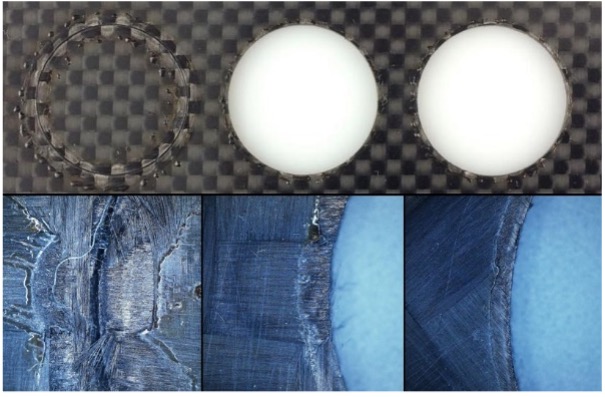
This image shows the difference between the performance of two single-wavelengthsystems (10.6 µm on the left and 1.06 µm in the center) and a MultiWave Hybrid system (right) when cutting in CFRP. The top row shows the ½” (12 mm) diameter cuts in full scale. The bottom are the same cuts under magnification. The MultiWave Hybrid process results in the smallest Heat Affected Zone (HAZ) and fewest frayed fibers.
Additionally, the ease of use is greatly improved, especially when working with unique materials. With ULS' Intelligent Materials Database, the ULTRA systems are able to automatically provide the optimized laser settings for the MultiWave Hybrid™ processes.
Rapid Reconfiguration is another patented technology that further leans into this development, allowing users to very simply install and reinstall any ULS laser source onto any ULS laser system. The ULTRA series is ready to meet your ever-changing business needs.
Laser system development: Firmware and software upgrades
All ULTRA systems are controlled by a comprehensive and modern control software platform called the Laser Systems Manager or LSM. The LSM contains an enhanced set of features, contemporary user interface, and an extensive array of operator controls typically found in very robust CNC systems. The LSM contains numerous functions and capabilities designed to provide operators extreme control over laser processing parameters. LSM upgrades can be manufacturer or user-initiated and are completed over the internet. Extensive security and administrative protocols are, of course, in place to prevent any unwanted outside access to your system or changes to job files.
Highly valuable customer feedback has already been incorporated into the LSM and Universal's ULTRA development roadmap. The next series of ULTRA system platforms will integrate new features or capabilities for the systems. Universal is committed to ensuring that their laser systems are delivering significant value, now and in the years to come.
High-precision control for laser engraving
All systems in Universal's ULTRA series offer high levels of X, Y and Z-axis control. Using a mechanical autofocus touch sensor mounted on the laser system carriage, systems determine the optimal focus for each material and workpiece. This is superior to optical, ultrasonic, and photo sensor methods because of its broader applicability. The mechanical system offers the same accuracy for transparent, anechoic, or even reflective surfaces and is able to adjust to different materials in the same process run.
And the flagship X6000 takes the ULTRA's accuracy to a whole other level. Its minimum addressable beam positioning is 2 microns with a mechanical positioning repeatability of about 10 microns. The accuracy and consistency this unlocks ensures that customers accomplish the same part level consistency, even if the systems are placed at different locations, with different operators.
Laser systems: Process development support
Universal is providing process development support for ULTRA customers. This means that they will help determine the optimal parameters (and configuration) that will lead to the result you are looking for. Laser 2000 and ULS technicians from offices all over the world will work with clients following a process methodology that has been designed to generate high-quality and, most importantly, consistent results. Key phases in this process are:
- Determining process optimization objectives
- Characterization of materials
- experimentation
- Process parameter optimisation
Determining the optical absorption properties of a material is straightforward, but experimentation never is. We carefully alter and control variables to determine the optimal laser processing parameter settings that fit your objectives. Of course, this analysis is already available to ULS customers for a wide range of materials and composites.
And this is not just for new customers, often we work with long term customers when they want to take the next step. Developing or updating a new product often requires new processes or even the use of new materials, fundamentally changing the current setup of your laser system is a necessity. By making full use of our knowledge and experience you can kickstart your (re)development process.
Would you like to know more about Universal's ULTRA laser systems or do you need advice about laser systems in general? Please contact our specialist, Ruben van Rossum, directly using vanrossum@laser2000.nl or call + 31-297-266191.